AI-Powered Code Migration: Modernizing Legacy Applications for the Future
Future of Legacy Application Modernization with AI
Seasia, being a well-known world-class enterprise software development company, serves small, medium, and large-sized businesses in a seamless and secure manner. We enable competitive digital strategies within your organization that will boost your business. We work around different business verticals for the assured growth of your business. Our persuasive and effective solutions are known to outperform competitors. We identify, evaluate and develop strategic business relationships to provide the best possibilities in the industries. Our main goal is to craft innovative digital experiences with cutting-edge technologies.
Maintaining legacy applications forces engineering leaders to make hard operational trade-offs. Enterprise environments often feature monolithic architectures, legacy runtimes, and deprecated language frameworks. Over time these components add significant maintainability overhead, increase technical debt, and introduce critical security holes.
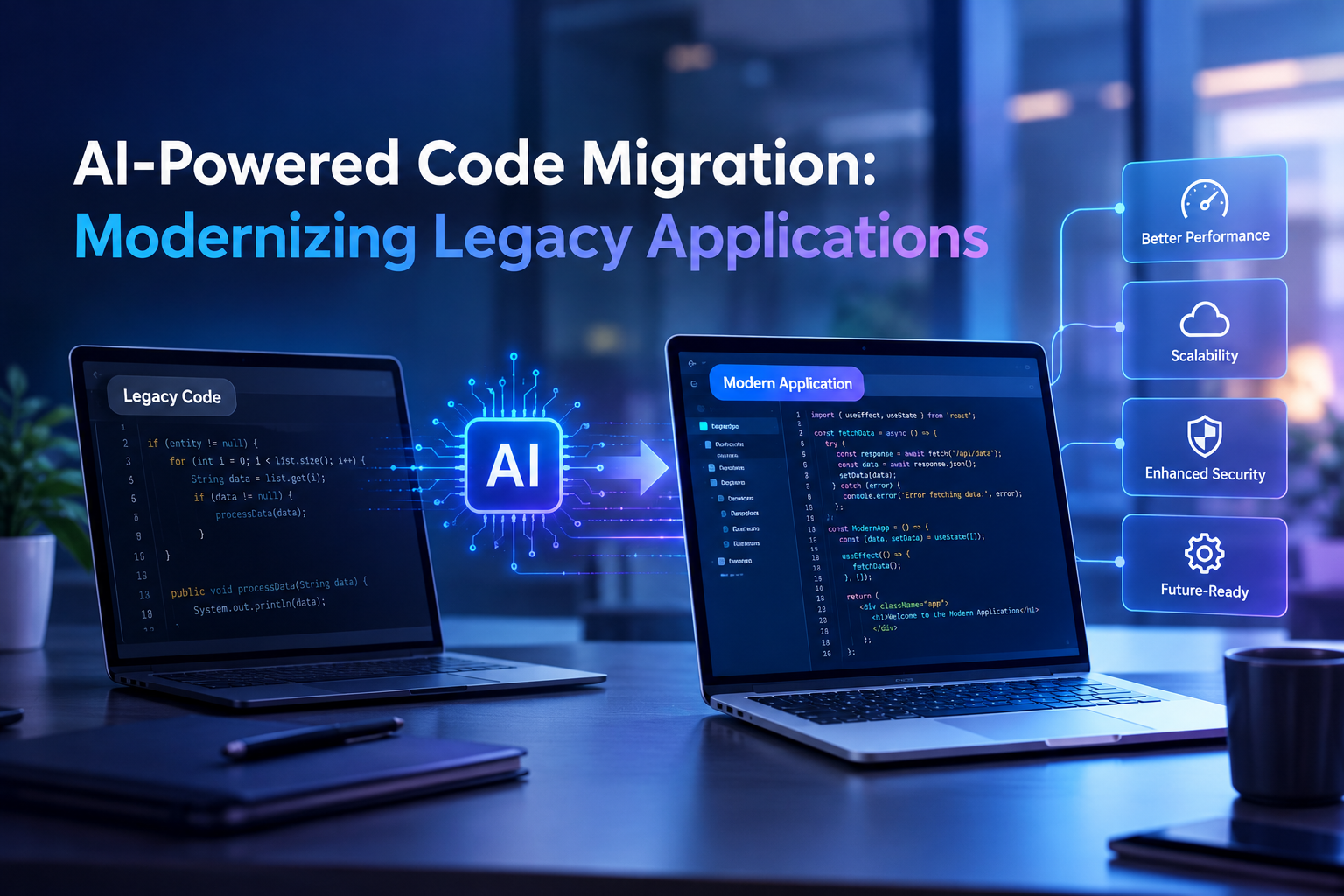
Historically, replacing legacy software meant expensive, high-risk full-system rewrites, many of which stalled or failed to reach production parity. Today, you have engineering-centric options like AI-powered code migration. Technical teams can systematically refactor legacy applications into modular, cloud-native architectures without interrupting active business operations by integrating Abstract Syntax Tree (AST) parsing, static code analysis and large language models (LLMs).
The Structural Drivers of Technical Debt
Technical architects should quantify the technical debt of legacy systems before starting any architectural change.
Architectural Monoliths- Tight coupling between data access layers, business logic and UI elements means they cannot be scaled independently and that there are severe regression risks during routine deployments.
Knowledge Decay & Missing Specifications- When core system maintainers leave, original business requirements are trapped inside raw source code and undocumented stored procedures.
Deprecation & Security Exposure- Unmaintained third-party dependencies, outdated SSL/TLS libraries and EOL framework runtimes have created critical SAST/DAST vulnerabilities in core application environments.
Sub-optimal Compute & Throughput- Legacy applications built for bare-metal servers aren’t optimized for containerized, auto-scaling cloud topologies, which inflates cloud infrastructure budgets.
Technical Workflows for AI-Driven Modernization
Embedding AI models into modern engineering pipelines turns legacy application modernization into a structured, highly deterministic automated refactoring workflow, instead of a risky manual effort.
1. Automated Static Analysis and Dependency Graphing
LLM-based analysis engines consume thousands of source repositories to build complete abstract syntax trees and component dependency graphs. This process maps hidden API endpoints, database queries and inter-service couplings automatically before any refactoring occurs.
2. Automatic Code Refactoring and Language Translation
The iterative syntax conversion (COBOL, PL/SQL, legacy .NET to the modern Java, Go, TypeScript, etc.) requires a high level of precision. AI-powered code migration tools ease this transformation by directly mapping old language paradigms to clean, idiomatic patterns, design interfaces, and modern REST/gRPC contracts.
3. Automated Characterization Test Generation
For functional equivalence, AI agents analyze runtime inputs and execution traces to automatically generate characterization test suites. These tests establish a baseline for operation, ensuring that refactored services have exact legacy behavior for all edge cases.
4. Code Base Clean Up and Documentation
AI models analyze complex legacy procedures to generate clear human-readable documentation. They document data pipelines, identify dead code paths, and describe operational steps, greatly easing the burden on current engineering teams to support transformed systems.
Architectural Governance - Balancing Automation with Human Audit
Large language models are good at syntax at scale, but they don’t have the business context. An AI agent cannot determine by itself if an anomaly in a legacy calculation is an undocumented edge-case requirement or a historical software bug.
Therefore, enterprise- grade engineering teams enforce a disciplined Human-in-the-Loop (HITL) refactoring pipeline-
System Architecture Design- Lead architects define target microservice topologies, database schemas and security standards.
AI Refactoring Engine- Coding agents provide syntax translation, character tests, and generate API interfaces.
Engineering Code Review & Validation- Before these are merged into the main branches, each senior software engineer will review the pull request, validate business logic is aligned, and ensure static analysis checks pass.
Many organizations choose to cooperate with the technical ai ai development servicesservices to create auditable, resilient continuous integration pipelines, automated static checks and code-review gates to reach this balance.
Major Benefits of AI-Powered Modernization
Accelerated Engineering Velocity- Automated syntax translation and boilerplate generation reduced total refactoring timelines by up to 50%.
Cost-Effective Utilization of Resources- Moving repetitive conversion work to AI allows senior engineers to focus on system architecture and performance improvement.
Zero-downtime migration- By using phased patterns such as the Strangler Fig pattern, you can replace services behind an API gateway in a controlled manner without affecting live user traffic.
Preservation of Core Business Logic- Automated characterization testing ensures that decades of refined business rules are preserved through the migration process.
Concluding Remarks
Mission-critical legacy applications don't need multi-year, high-risk software rebuilds to migrate. A structured, phased approach to modernization with AI-powered code migration can help engineering teams efficiently address technical debt, improve system security, and scale modern cloud infrastructures.
But artificial intelligence is at its best a powerful velocity multiplier, not an autonomous decision maker. The most resilient modernization programs combine machine-learning automation with rigorous human code review, careful characterization testing, and strategic counsel from dedicated AI and ML Services.
Set to fast-track your software modernization journey? Connect with our enterprise system architects today to build a secure, phased migration framework that matches your infrastructure.
Frequently Asked Questions
What is AI-powered code migration?
AI-powered code migration is the application of machine learning models, static code analysis, and automated syntax translation tools to analyze, refactor, document, and modernize legacy software codebases into modern target architectures.
How does AI help modernize legacy applications?
AI parses legacy repositories, constructs dependency graphs, converts deprecated syntax to modern programming languages, generates characterization test suites, and produces clear architectural documentation to streamline overall legacy application modernization.
What are the benefits of using AI for legacy code migration?
Primary benefits include faster time-to-production, reduced engineering expenditure, automated test generation, fewer manual syntax errors, and complete preservation of implicit business rules.
Can AI-powered code migration reduce the cost and time of application modernization?
Yes, by automating labor-intensive tasks like code translation, test scaffolding, and dependency mapping, AI-assisted migration workflows routinely reduce project timelines and operational costs by 40% to 50%.
What challenges should businesses consider when migrating legacy applications with AI?
Key considerations include managing non-deterministic model outputs, enforcing mandatory peer reviews by senior developers, maintaining strict data privacy during code ingestion, and running comprehensive regression tests to prevent functional drift.
